Can 999 Pure Silver Be Engraved? A Silversmith’s Bench Guide
Yes, 999 fine silver can be engraved. The practical question is how the engraving method, ring dimensions, surface finish and placement work together.
999 fine silver is described as 999 parts silver per 1,000, or 99.9% silver. That tells you the fineness of the material; it does not, by itself, tell you the exact trace composition, hardness, thickness or engraving limits of a particular ring.
Why softness matters at the jewellery bench
Fine silver is relatively soft and malleable compared with harder silver alloys. That can make it responsive to a graver, but it also means a thin band can deform if it is poorly supported or clamped with excessive pressure.
This is why engraving should be planned around the actual ring. The maker needs to consider the band’s width, thickness, curvature, finish and whether the text will be placed inside or outside. There is no single thickness rule that safely applies to every ring design.
Three ways to engrave 999 silver
1. Laser engraving
Laser engraving applies concentrated energy to the surface without the same cutting pressure as a hand tool. It can be useful when preserving the ring’s shape is a priority, but the result still depends on the machine settings, surface support, curvature and desired contrast.
Laser marking may look bright, frosted or darker depending on the treatment. Do not assume that every laser creates the same colour or depth.
2. Hand engraving
Hand engraving uses a graver to cut lines into the metal. It can create bright facets and an unmistakably handmade result, but it requires control and suitable support. On a soft material, an uncontrolled slip can leave a deeper mark than intended.
The final appearance depends on the maker’s technique, the lettering style and the ring’s surface. A short, clear inscription is generally easier to execute and read than a long line of fine script on a narrow or textured band.
3. Punch stamping
Punch stamping displaces metal rather than removing it in a continuous cut. On a soft, curved band, impact can affect the profile if the ring is not properly supported.
Whether stamping is appropriate depends on the ring’s construction and whether it is done before or after forming. This is a decision for the maker, not a home experiment with a hammer and loose alphabet punches.
Inside or outside: where should the text go?
An interior inscription is usually exposed to fewer impacts from desks, tools, keys and door handles than an exterior inscription. That does not make it permanently unchanged: contact with skin, resizing, polishing and later repairs can still affect legibility.
An exterior inscription receives more direct contact with the environment. If you want outside text, ask the maker how the depth, font and placement are chosen for the exact ring. Bold lettering may remain easier to read than very fine script, but the maker should confirm what is suitable for the available surface.
Can matte or textured rings be engraved?
Sometimes. A smooth area is usually easier to read than a heavily textured area, and engraving can change the appearance of a deliberately matte or satin surface around the inscription.
Before ordering, confirm whether the text will sit on a smooth panel, across the existing texture or on another prepared area. Product photographs alone cannot show the exact tactile result.
What should you engrave?
Short text is usually the safest starting point: initials, a date, a brief phrase or a small symbol. Before submitting the final wording, confirm the maker’s rules for:
character count;
capitalisation, punctuation and symbols;
lettering style;
inside or outside placement;
proof or confirmation process;
production and dispatch timing;
changes, exchanges and returns for personalised work.
Never assume that an online text field proves a phrase will fit. The final text should be checked against the actual engraving area.
Care after engraving
Clean an engraved 999 silver ring with a method appropriate for its actual finish. Mild soap, water and a soft cloth may be suitable for some plain metal rings, but a deliberately matte, textured, darkened or mixed-material piece may need different care.
Avoid abrasive polishing and chemical cleaners unless the maker confirms they are suitable. A cleaner can alter a surface treatment or reduce contrast in a darkened inscription. Do not try to deepen, re-cut or straighten an engraved ring at home.
Ask these questions before ordering
Is engraving available for this exact ring?
Which method will be used?
Where will the inscription be placed?
What text length and symbols are supported?
Could the engraving affect later resizing, repair or exchange?
How should the finished ring be cleaned?
Keep a copy of the final text and the maker’s confirmation. Check every letter before payment.
Is engraving available from Forged by You?
This should be confirmed from the current product page and checkout flow for the selected ring. A visible text field or older product wording should not be treated as proof that the service is currently available or that every ring accepts the same options.
If engraving is offered, follow only the options and limits displayed for that product. If the information is unclear, contact the studio before ordering.
Final answer
Yes, 999 pure silver can be engraved. The quality and durability of the result depend on the ring’s structure, surface, engraving method, placement and care. Choose a maker who can explain those details for the exact ring, and confirm the text and personalised-item terms before ordering.
Editorial review notes — not for publication
Confirm current WooCommerce engraving availability, cart/order persistence and fulfilment rules before adding store-specific claims.
Do not add unsupported hardness values, minimum thicknesses, engraving depths or fixed lifespans.
Do not claim zero risk, permanent legibility, no tarnish, no skin discolouration or universal suitability.
Matte, Textured or Reflective: How to Choose a Silver Ring Finish
When choosing a silver ring, the finish can matter as much as the metal. A reflective surface catches light and looks clean. A matte surface feels quieter and usually draws less attention to bright reflections. A textured surface gives the ring more visual movement and makes small changes from wear part of its character.
There is no universally best finish. The right choice depends on how much contrast, shine and visible change you want from a ring you may wear every day.
What does “ring finish” mean?
The finish is the appearance and surface texture created after a ring has been formed and worked. It can be polished, satin-like, brushed, matte, textured or a combination of treatments.
Finish is not the same as metal purity. A 999 fine silver ring can have a reflective, matte or textured surface. The finish also does not tell you everything about a ring’s strength, thickness or construction. Check the product description for those details rather than judging them from a photograph alone.
Reflective silver rings: for light and contrast
A reflective finish returns more light from the surface. It can make a simple band look crisp and defined, especially against darker clothing or skin tones. It is a useful choice if you want the ring to feel visually clear and notice the shape of the band from a distance.
Choose a reflective finish if you prefer:
a brighter, cleaner-looking surface;
visible highlights when your hands move;
a finish that photographs with clear light and shadow;
a simple ring with a more polished visual presence.
The trade-off is that reflections can also show fingerprints, surface marks and changes in lighting more clearly. On a fine-silver ring, normal contact with desks, tools and other hard surfaces may gradually change the surface. That is ordinary wear, not automatically a sign that the ring is defective.
Matte or satin silver rings: for a quieter look
A matte or satin-like finish diffuses light instead of reflecting it sharply. The result is usually softer and less high-contrast. This can suit someone who wants a minimal ring that does not dominate an outfit or compete with other jewellery.
Choose a matte or satin finish if you prefer:
a restrained, low-shine appearance;
a softer visual effect for everyday outfits;
less emphasis on bright reflections;
a band that feels understated rather than decorative.
“Matte” is not a guarantee that a surface will never show wear. Rubbing, contact and cleaning can still alter the appearance of a finished surface. Ask the maker how the specific ring should be cleaned, especially before using any polishing cloth or metal product that could change the finish.
Textured silver rings: for surface character
A textured finish introduces small variations across the surface. These may be regular, irregular, granular, hammered or hand-worked, depending on how the ring was made. Texture can make a narrow band feel more visually distinctive without adding stones, colour or a large logo.
Choose a textured finish if you prefer:
visible surface detail up close;
a ring that changes as light moves across it;
a more tactile, handmade impression;
a finish where minor marks are part of a changing surface rather than the only visual feature.
Texture is not the same as roughness, and a photograph cannot fully show how a particular surface feels. If touch matters to your decision, look for close-up images and read the maker’s description. Do not assume that every textured finish has the same level of relief or comfort.
Which finish is easiest to live with?
The honest answer depends on what you notice most. A reflective finish may make marks easier to see because it creates stronger highlights. A matte finish may make the ring look quieter, but it can still develop polished areas from contact. A textured finish may make small changes less visually uniform, while deeper texture may need more careful cleaning.
For any finish, a few habits help:
Remove the ring before work that could strike, crush or bend it.
Keep it away from chemicals and abrasive household cleaners.
Rinse away soap residue and dry the ring fully when cleaning is appropriate.
Ask the maker before using polish on a deliberately matte or textured surface.
Expect a hand-finished ring to record some contact and wear over time.
These habits do not preserve a finish permanently. They simply reduce avoidable damage and help you choose a care method that matches the surface.
A simple way to choose
Ask yourself three questions:
Do you want the ring to catch attention?
Choose reflective if bright highlights and a clearer, polished look appeal to you. Choose matte or satin if you prefer a quieter presence.
Do you want the surface to be the main detail?
Choose textured if you enjoy close-up variation and a more tactile handmade character. Choose a simpler matte or reflective surface if the band’s outline matters more than its surface detail.
Are you comfortable with visible change?
Every ring changes through contact, but people notice that change differently. If you want a ring that looks intentionally understated from the start, matte may feel right. If you enjoy seeing light and wear develop across the surface, reflective or textured may be a better match.
Before you order
Read the current product page for the exact ring width, material, finish description, care guidance and available sizes. Product photographs can communicate the overall look, but they cannot guarantee the exact feel of a surface on your hand.
You can begin with the current ring collection and check the ring size guide before ordering. If you are unsure how to care for a particular finish, contact the studio before using a cleaner or polish.
Final takeaway
Reflective finishes suit people who want light, contrast and a clear polished presence. Matte or satin finishes suit people who prefer a quieter, softer look. Textured finishes suit people who want the surface itself to carry visual and tactile character.
The best finish is the one whose normal changes you are comfortable seeing. Choose the surface first, then confirm the ring’s material, dimensions, size and care instructions on the current product page.
Editorial review notes — not for publication
Do not add specific product names, finish claims or product URLs until the current WooCommerce catalogue is re-read.
Do not claim that one finish is more scratch-proof, durable or low-maintenance without product-specific evidence.
Do not claim that matte, textured or reflective surfaces prevent tarnish or hide all wear.
Before publication, confirm the Shop and Size Guide links, author/byline, featured image, category and final product-specific internal links.
The number 925 describes silver content: 925 sterling silver contains 92.5% silver. It is a useful material description, but it does not tell you everything about a ring. It cannot, by itself, confirm who made the piece, how accurately it was produced, what finish was applied, or whether a seller’s description is reliable.
What does 925 mean on silver?
Rio Grande’s guide to jewellery fabrication metals describes 925 sterling silver as an alloy made from 92.5% silver and 7.5% copper. Adding copper increases hardness and strength compared with fine silver.
That definition explains the fineness of the metal. It does not turn “925” into a complete ingredient list for every item sold in every market. If the precise composition matters, request documentation for the specific piece rather than assuming more than the seller has stated.
Is 925 silver the same as sterling silver?
In the material definition used by Rio Grande, 925 identifies sterling silver: 92.5% silver with the remaining 7.5% described in its guide as copper. The terms “925 silver” and “sterling silver” therefore refer to the same silver proportion in that source, rather than two different purity grades.
This is separate from silver-plated or silver-filled construction. Those descriptions refer to a silver-containing layer over another material, not a piece made throughout from sterling silver. Read the complete material description; a product title alone may not answer that question.
Does a 925 stamp prove quality or authenticity?
A 925 mark is one piece of information, not a complete quality assessment. Schedule 2 of the UK Hallmarking Act 1973 lists 925 as a silver standard of fineness. The same legislation distinguishes the standard mark from the assay-office mark used in a hallmark after assay. A standalone number therefore should not be treated as proof of the seller, construction, finish, sizing or workmanship.
Before buying, separate four questions:
Material: Does the listing identify sterling silver, silver plate, silver-filled material or another construction?
Evidence: Are there clear photographs and a consistent written description of the actual item?
Fit: Does the seller provide a usable size guide and explain how size-related exchanges work?
Support: Can you find current contact, shipping, return and quality-support information before paying?
If the material itself must be authenticated, use appropriate documentation or qualified testing. Do not treat colour, a photograph or a stamped number as a complete test on its own.
Is 925 or 999 silver better for a ring?
The higher number does not settle every buying decision. Rio Grande describes fine silver as soft and malleable, while copper alloying makes sterling silver harder and stronger than fine silver. Those material properties create a trade-off; they do not make every ring in one material better made than every ring in the other.
What should you check before buying a 925 silver ring?
Read the full material description and look for any distinction between solid sterling silver and a silver surface over another material. Review photographs of the edges, joins, settings and finish. Check sizing and the seller’s current policies before ordering, especially for engraved or personalised pieces.
Forged by You’s current ring listings describe the available rings as 999 fine silver, not 925 sterling silver. The shop shows the current range, while the ring size guide and published policy pages explain the current ordering support. Refer to those live pages for details rather than relying on policy wording copied into an article.
UK Hallmarking Act 1973, Schedule 2. Used to identify 925 as a silver standard of fineness and to distinguish the standard mark from the assay-office component of a hallmark. Live text checked 26 August 2026.
Can You Wear a 999 Fine Silver Ring Every Day? Start With Your Routine
A 999 fine silver ring can be chosen for regular wear, but “every day” is not one fixed level of use. A desk-based routine, repeated contact with hard tools and lifting heavy objects place very different demands on a ring. The useful question is not whether fine silver is universally suitable; it is whether you accept visible surface change and can remove the ring when an activity may bend, dent or deeply mark it.
Fine silver contains more silver than sterling silver and is softer. Rio Grande notes that fine silver is often too soft for many jewellery applications, which is why silver is commonly alloyed to make sterling silver more durable. Forged by You’s current bands are made from 999 fine silver, so scratches, small dents and finish changes should be treated as possible wear—not hidden behind a durability promise.
Start with what your hands do
Before choosing a daily ring, list the activities that bring your hands into contact with hard surfaces, pressure or chemicals. If your routine includes lifting, gripping tools or work where a ring can catch, remove it for that task. This is a practical limitation, not a judgement about whether the ring is “good” or “bad”.
If your routine is lower-impact and you are comfortable with marks developing, a simple band may fit the way you want to wear jewellery. Forged by You can personalise a ring with a name. This personalisation does not change how 999 fine silver responds to force or surface wear, so the guide does not rank an engraved ring as more durable than an unengraved one.
Choose the surface change you can live with
The three current bands differ in finish:
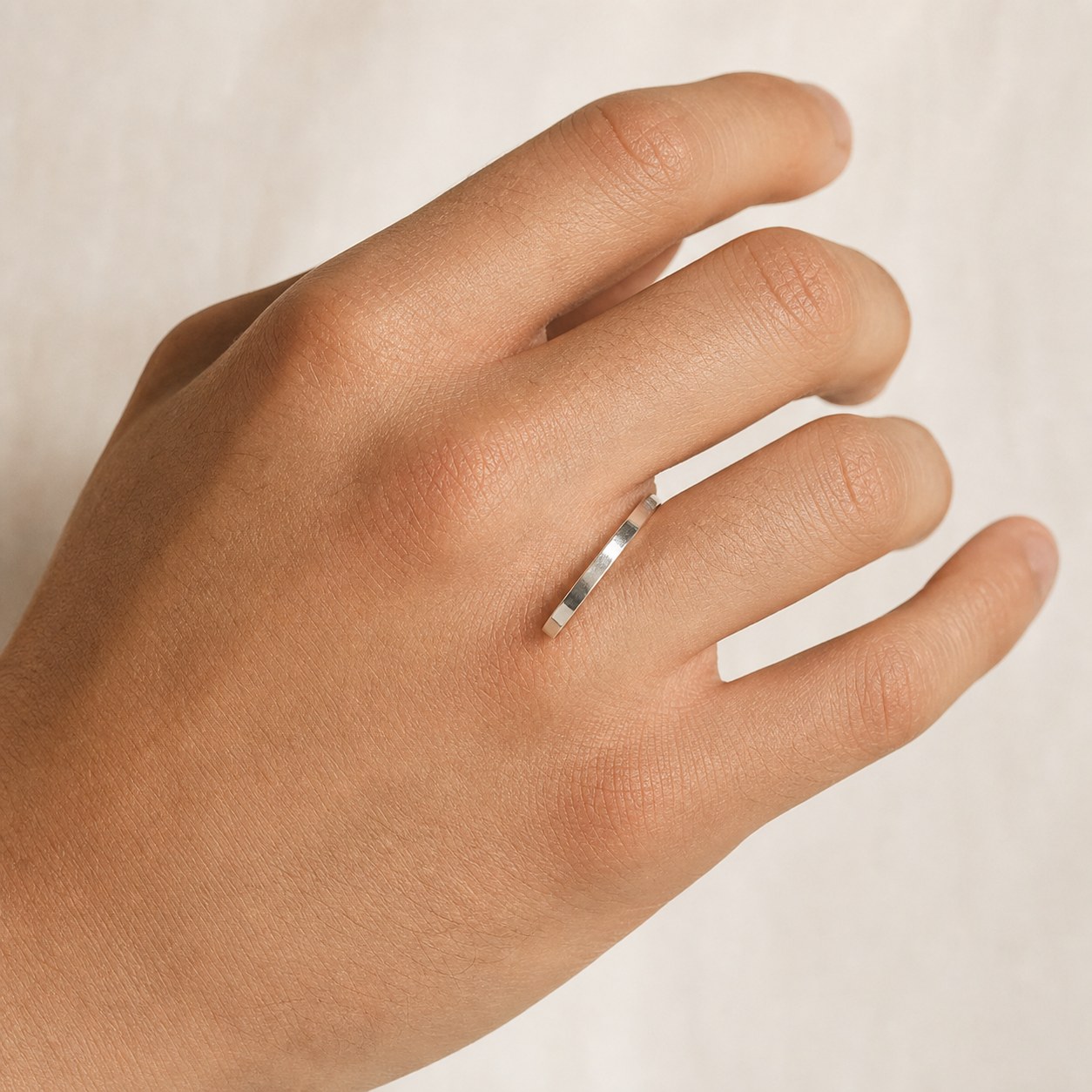
Mirror Trace has a reflective face with subtle hand-finished marks.
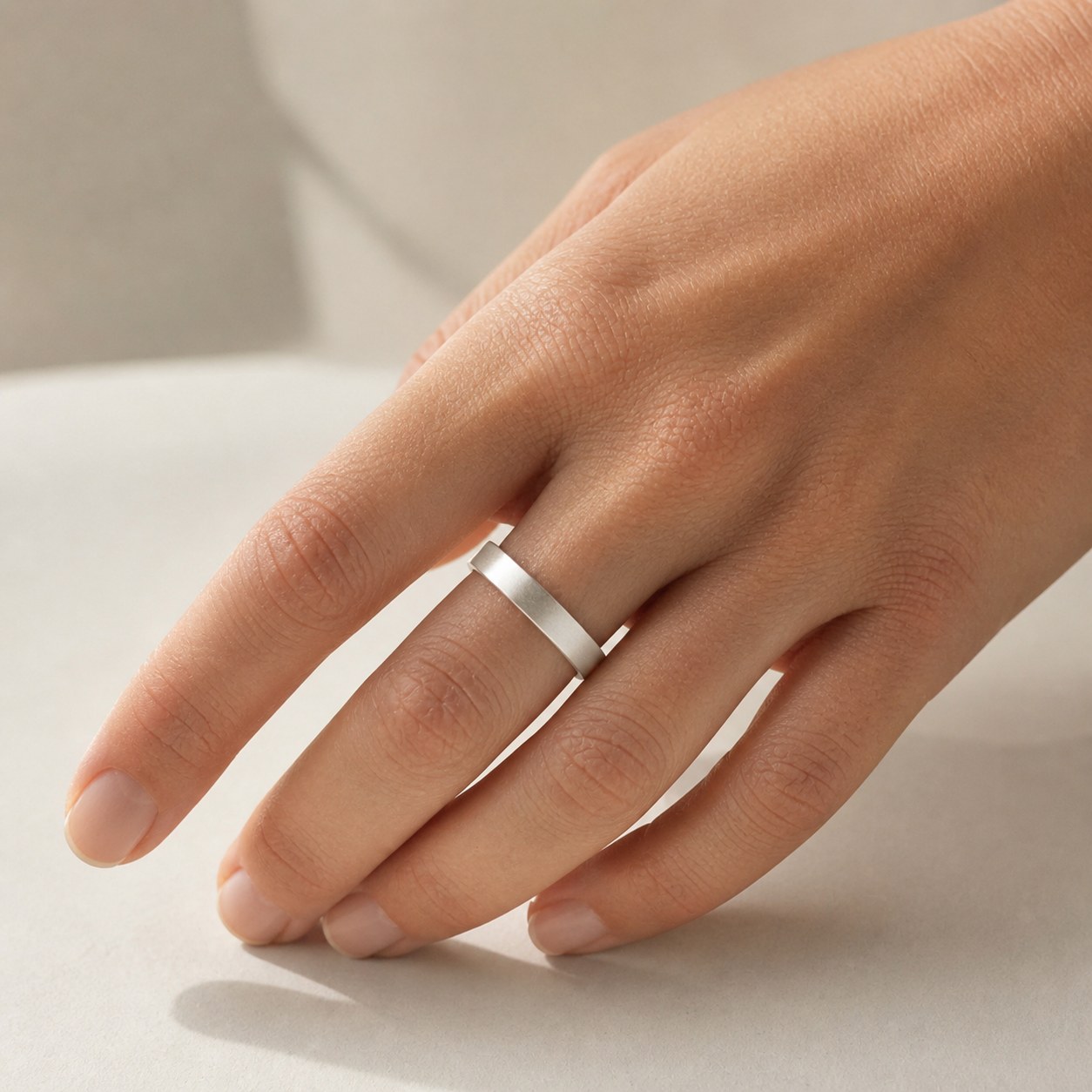
Satin Weight has a satin-matte face and a broader-looking profile.
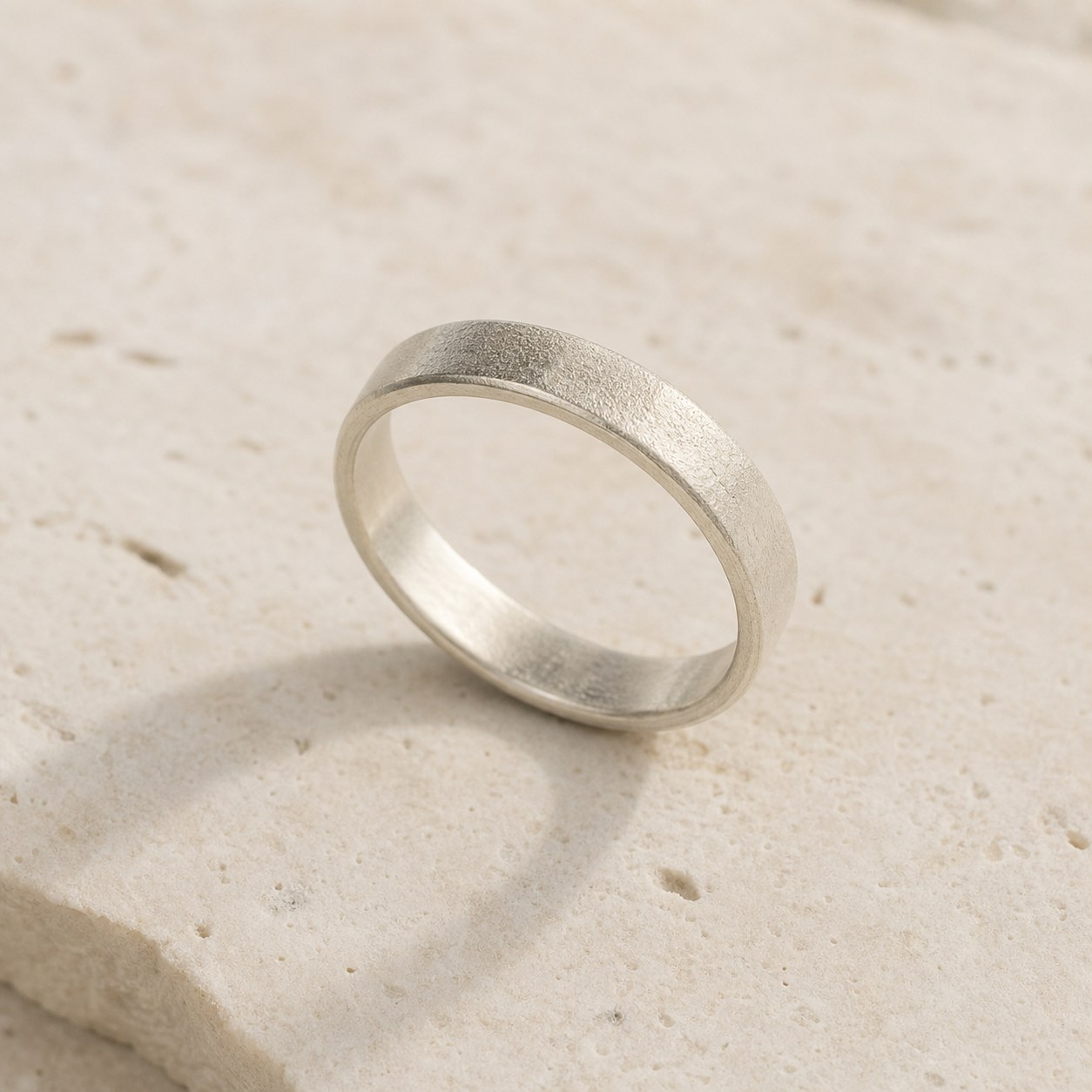
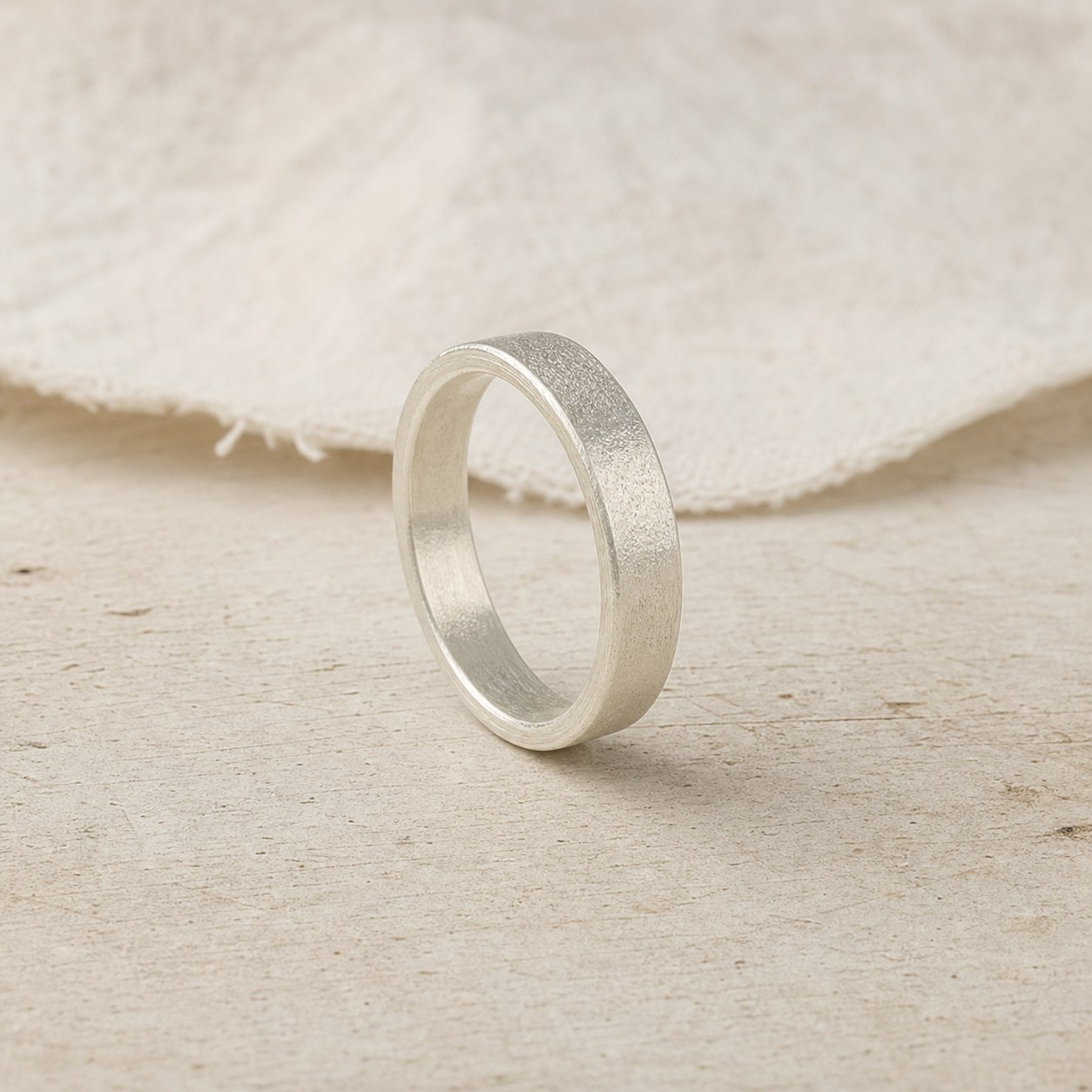
Quiet Texture has a fine granular matte texture and a slim profile.
These descriptions come from the current WooCommerce product records. They describe appearance, not tested resistance to scratching or denting. The existing finish guide shows the surfaces in more detail without claiming that one finish will stay unchanged longer.
Separate wear marks from tarnish
A scratch or dent is a physical change to the surface. Tarnish is a chemical surface reaction and can darken silver. They are not the same problem, and a dark surface does not by itself prove that a ring is fake. The site’s fine-silver tarnish guide explains the mechanism; the blackening myths guide covers what darkening can and cannot tell you.
A practical decision rule
Choose a 999 fine silver band for regular wear only if both statements are true: you are comfortable with the surface recording use, and you are willing to remove the ring for activities that could place it under force or expose it to avoidable damage. If you want a ring to resist visible change, compare other metals and constructions with a qualified jeweller before buying.
Silver Jewellery Turned Black? What It Does—and Doesn’t—Tell You
If a silver ring turns black, it does not automatically mean the silver is fake.
Silver can react with sulfur-containing gases in the air, forming a layer of silver sulfide at the surface. As that layer grows, the colour may pass through yellow, red-brown or blue before it looks black.
So when a dark patch appears, hold off on the verdict—and on the strongest cleaner you can find. Colour tells you that the surface has changed. On its own, it cannot tell you exactly what the ring is made from, why it changed or how it should be cleaned.
Blackening is not a silver test
Pure silver can tarnish. The Canadian Conservation Institute identifies silver sulfide as the tarnish found on pure silver, produced when the metal reacts with sulfur-containing gases. Real silver and a dark surface are not mutually exclusive.
If the material needs to be confirmed, look to a hallmark, a reliable product record or appropriate professional testing—not the colour in a photograph. Forged by You lists its current bands as 999 fine silver, meaning 99.9% silver.
Purity can change the rate, not remove the possibility
In a controlled comparison described by the Institute, sterling silver tarnished faster than pure silver because the copper in the alloy is more reactive. Yet the same source documents silver sulfide on pure silver.
Purity can influence the rate; it cannot promise an unchanged surface. The concentration of sulfur-containing gases and the relative humidity also affect how quickly tarnish develops. That is why a single timeline for every ring would be misleading.
Colour and texture are different clues. One dark area rarely tells the whole story.
Look at the surface before reaching for a cleaner
A black mark is not necessarily all tarnish. A ring may also carry dirt, skin oils, other residues, scratches or changes to its finish. More than one of these can be present at once, and a photograph may not show the difference.
Look at the whole ring, not only its darkest spot. If you are unsure about the material, a coating, an inlay or the intended finish, ask the maker or a qualified professional first. The wrong treatment can alter the surface without addressing the actual problem.
“Shiny again” is not the same as “back to new”
Polishing is not a neutral reset. The Institute notes that polishes are abrasive: they remove tarnish and some silver, leaving a pattern of fine scratches. It also advises against general-purpose metal polishes on silver because they are more abrasive and remove more material.
That distinction matters on a reflective, satin or granular finish. A polished patch can end up looking different from the area around it. Familiar household ingredients do not make an online cleaning method suitable for every ring.
If the original finish matters to you, work out what you are trying to remove: colour, residue or signs of physical wear. Cleaning may change the colour without recreating the maker’s original surface. When the construction or finish is unclear, get advice for that specific piece before moving to a stronger product.
The texture on a hand-finished surface is deliberate. Cleaning can change it.
Choose a finish you are willing to live with
Forged by You currently offers three hand-finished 999 fine silver bands. Mirror Trace has a reflective face with subtle hand marks. Satin Weight has a satin-matte face. Quiet Texture has a fine granular surface.
Rather than looking for a promise that silver will never change, start with a finish you like and are willing to care for. Compare the three 999 fine silver bands.
How to Measure Your Ring Size at Home in Australia
The most useful at-home starting point is a ring that already fits the intended finger. Measure its inside diameter, compare that measurement with a size chart, and treat the result as an estimate rather than a guarantee. If the purchase matters or the fit is uncertain, a jeweller can check the finger with sizing gauges.
Forged by You currently asks shoppers to choose a US ring size from 5 to 12. The site’s ring size guide lists the corresponding inside diameters and finger circumferences in millimetres and centimetres.
Method 1: measure a ring that already fits
Choose a plain, round ring worn comfortably on the same finger and hand.
Place it on a flat surface.
Measure straight across the opening at its widest point, from one inner edge to the opposite inner edge. Do not include the metal.
Record the inside diameter in millimetres.
Match that measurement to the closest entry in the Forged by You size chart.
This method depends on the reference ring being round and fitting the correct finger. The Gemological Institute of America notes that an inside measurement can be compared with a standard chart when the ring is perfectly round. A jeweller would normally use a ring stick or mandrel for a more controlled reading.
Use a ring that already fits the same finger comfortably as the reference.
Why paper and string are only rough estimates
Wrapping paper or string around a finger looks simple, but both can distort the result. String can stretch, paper can bend or curl, and a measurement taken only at the base of the finger may not account for the knuckle.
If a paper measurement is the only option, use it as a preliminary estimate and check that the proposed size can pass over the knuckle. Do not pull the strip tight enough to compress the finger. Repeat the measurement and seek a professional check when two readings disagree.
Fit is more than one number
A ring should pass over the knuckle without being forced, then sit securely without causing discomfort. Finger dimensions can also change with temperature and other conditions, so a single hurried measurement may not represent the fit you want.
Band width matters as well. GIA’s professional guidance uses different finger-sizing gauges for narrow and wide bands. That is another reason an at-home diameter is a starting point, particularly when changing from a slim band to a broader one.
A broader band may not feel identical to a slim ring in the same nominal size.
Before you order
Confirm that the reference ring belongs to the same finger and hand.
Use millimetres and measure the inside opening, not the outside edge.
Repeat the reading before choosing a size.
If the ring is not round, the result is unclear or the band width changes substantially, ask a jeweller to measure the finger.
ISO 8653:2016 — current standard describing ring-size measurement with a ring stick and finger gauge set.
Fine Silver Tarnish: What a Dark Surface Means Before You Clean It
999 fine silver can tarnish, and a dark surface does not automatically mean the ring is fake. Silver can react with sulfur-containing gases and form a surface layer of silver sulfide. As that layer develops, the colour may move through yellow, brown or blue before appearing dark grey or black.
Colour is only one clue. It cannot, by itself, confirm the ring’s composition, identify every residue on the surface or tell you which cleaning method is suitable. Before cleaning, work out whether you are looking at tarnish, surface dirt, physical wear, or more than one change at once.
Why fine silver can darken
The Canadian Conservation Institute describes silver tarnish as a surface reaction involving sulfur-containing gases. Relative humidity and the concentration of those gases affect how the tarnish develops, so there is no responsible fixed timeline that applies to every ring.
Fine silver’s high purity does not make its surface permanently unchanged. In a controlled comparison reported by the Institute, sterling silver tarnished faster than pure silver because copper in the alloy is more reactive. That comparison supports a difference in rate under those conditions; it does not establish that a 999 fine-silver surface stays unchanged.
What a black surface does—and does not—prove
Real silver and a black surface are not mutually exclusive. If composition needs to be confirmed, use a reliable product record, a hallmark where applicable, or appropriate professional testing. A photograph or a dark patch is not a material test.
Forged By You currently records its three published bands as 999 fine silver in WooCommerce. That store record supports the product description; it does not turn tarnish colour into a general authenticity test for unrelated jewellery.
Separate colour change from physical wear
Tarnish changes colour through a surface reaction. Scratches and dents are physical marks. A reflective, satin or granular finish can also become less uniform through handling and wear. These changes can appear together, but they do not have the same cause or the same remedy.
Texture and colour are different clues; inspect the whole surface before deciding what to change.
Why cleaning is not a neutral reset
The Canadian Conservation Institute advises examining silver before tarnish removal. Construction, coatings, inlays and the intended finish affect what treatment may be suitable.
Silver polishes are abrasive. They remove tarnish and some underlying silver, and they leave fine scratches. General-purpose metal polishes are more abrasive than products intended for silver. On a hand-finished ring, polishing one area can change the contrast or texture rather than recreate the maker’s original finish.
If the surface, construction or intended finish is unclear, ask the maker or a qualified professional before using a dip, general-purpose metal polish or an online household-ingredient method. This guide does not prescribe one cleaning method for every ring.
The starting texture is deliberate; cleaning can alter it.
Choose the starting finish you want to live with
Forged By You currently offers three hand-finished 999 fine-silver bands. Mirror Trace has a reflective face with subtle hand marks. Satin Weight has a satin-matte face. Quiet Texture has a fine granular surface.
What Is 999 Fine Silver? Purity, Feel and Everyday Wear
999 fine silver is silver with a stated fineness of 999: 999 parts out of 1,000, or 99.9% silver. For a ring, that high silver content creates a material that is softer and more malleable than traditional sterling silver. It can take on scratches, small dents and changes in its finish as it is worn.
That is neither a universal advantage nor a defect. It is the central choice. Pick fine silver if you value high silver content and are comfortable with a surface that records wear. Choose a harder alloy if keeping a crisper shape and finish matters more to you.
What does “999” mean?
The number is a fineness mark. It describes silver content in parts per thousand, so 999 means 99.9% silver. By comparison, traditional 925 sterling silver is 92.5% silver, with copper commonly making up the remaining 7.5%. Alloy recipes can vary, so “sterling” should not be treated as proof that every piece contains the same secondary metals.
Fine silver is softer and more malleable than sterling silver. On a ring, that means contact with hard surfaces can leave marks more readily. The exact result depends on the ring, the finish and how it is worn; there is no responsible fixed timeline for when a scratch or dent will appear.
The starting finish changes what you notice. A reflective face makes light and individual marks more visible. A satin-matte face diffuses reflections. A granular texture begins with a more tactile surface. Daily wear can alter all three, rather than leaving the original finish permanently unchanged.
Does 999 fine silver tarnish?
Fine silver can tarnish. Silver reacts with sulfur-containing gases and forms a surface tarnish layer. Its high purity does not make it “tarnish-proof,” and a useful care guide should not promise that it will remain unchanged.
Cleaning should match the condition of the piece and the finish you want to preserve. Polishing is abrasive: it can leave fine scratches and removes a small amount of silver. Avoid treating aggressive polishing as routine maintenance, particularly when the existing hand-finished surface is part of the design.
Is 999 fine silver right for an everyday ring?
It can be, if you accept the material on its own terms. Fine silver suits someone who:
wants a ring made with 99.9% silver;
likes a minimal band whose surface can change with wear;
is comfortable removing the ring when an activity risks impact or deformation; and
does not expect the ring to resist every scratch or dent, or to stay permanently bright.
A harder alloy may be the better choice if your priority is preserving sharp edges or resisting deformation. Fine silver is also not a guarantee against skin irritation. Reactions around jewellery can have several causes, including friction, trapped moisture or sensitivity to a metal; seek appropriate medical advice for a persistent reaction.
Three expressions of the same material
Forged by You currently offers three hand-finished 999 fine silver bands. Mirror Trace has a reflective face with visible hand marks. Satin Weight has a broader satin-matte face and rounded inner edge. Quiet Texture is a slim band with a fine granular texture and softened edges.
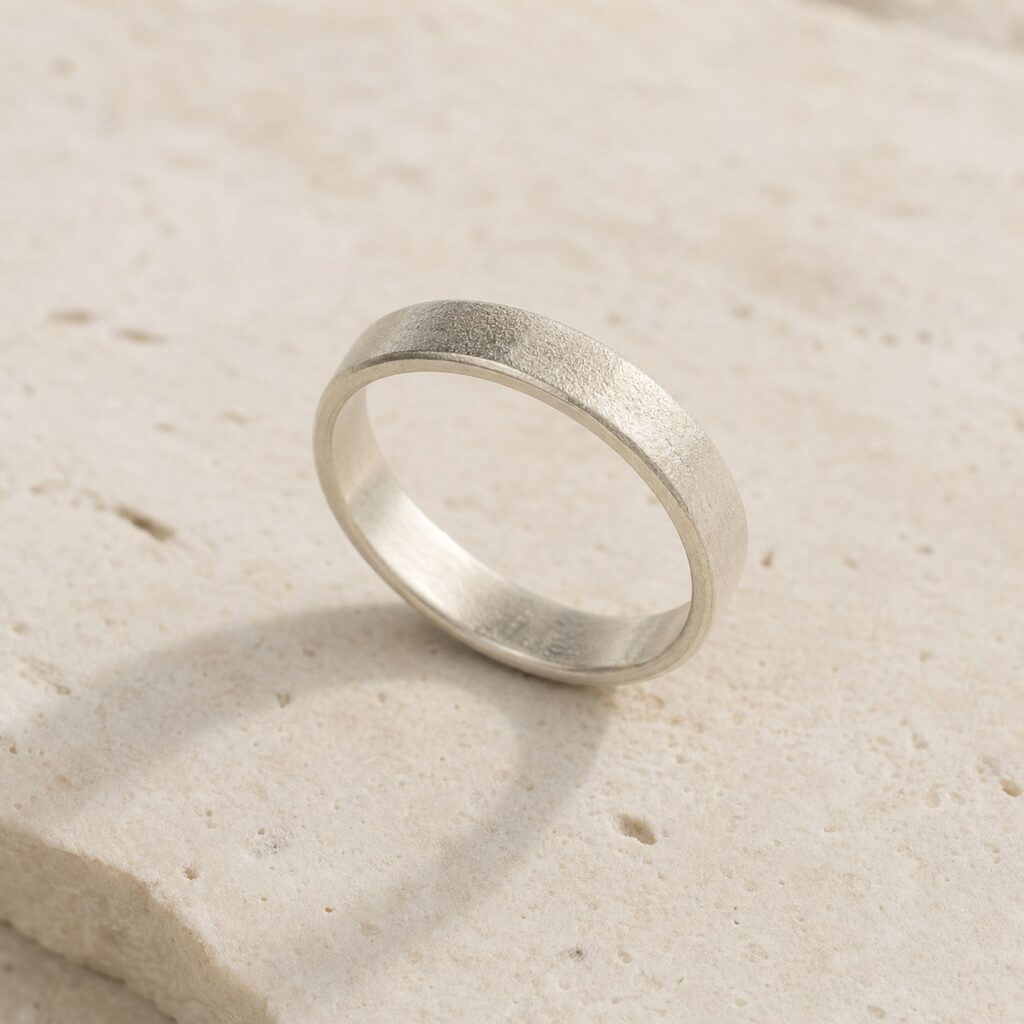
A close view of the granular hand-finished surface on Quiet Texture.
Reflective, Matte or Textured? How to Choose a Fine Silver Ring Finish
Start with two visible choices: how much reflection you want and whether you prefer a slim or broader band. Mirror Trace has a reflective face with visible hand-finished marks. Satin Weight has a broader satin-matte face. Quiet Texture is slim, with a fine granular matte surface.
All three current designs are made in 999 fine silver. The difference in this guide is the surface and profile you see—not a claim that one finish is higher quality than another.
Mirror Trace: reflection with the hand marks left visible
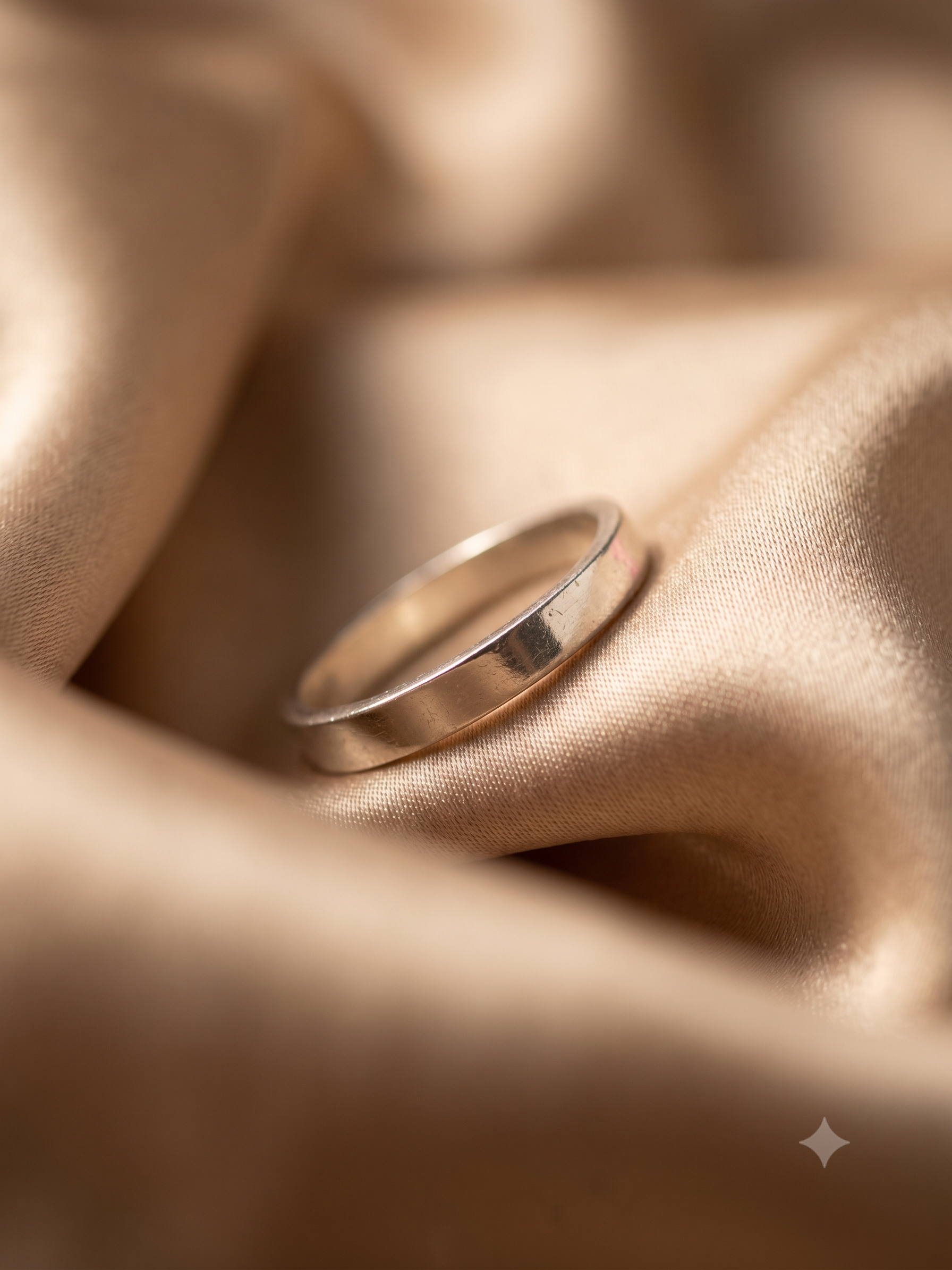
Mirror Trace close-up: a reflective face with hand-finished marks.
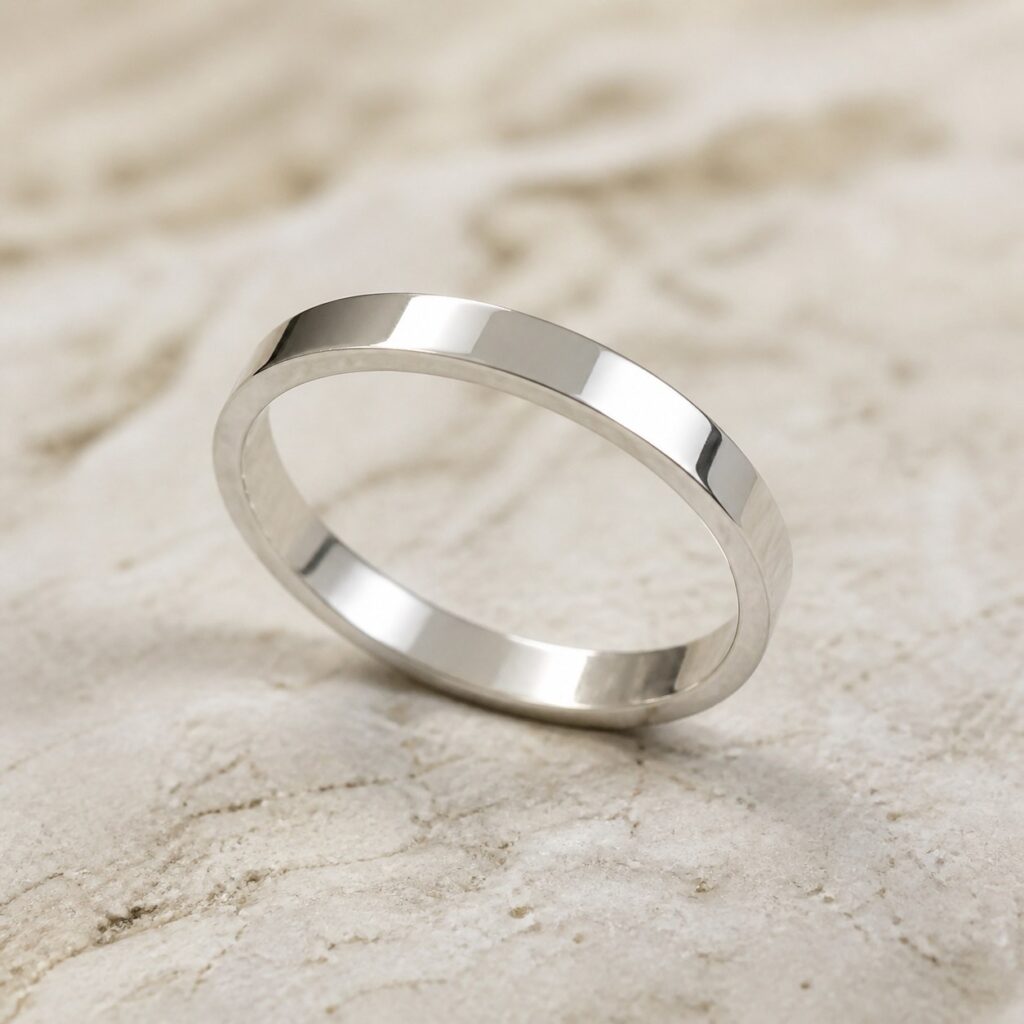
Mirror Trace is the brightest-looking option in the current collection. Its face reflects more light than the two matte designs, while the close-up shows that the finishing marks are still part of the surface.
Choose Mirror Trace if you want a ring that reads as reflective first, without presenting the face as mechanically uniform. Its listed profile is slim-to-medium.
Satin Weight: a broader face with softer reflection
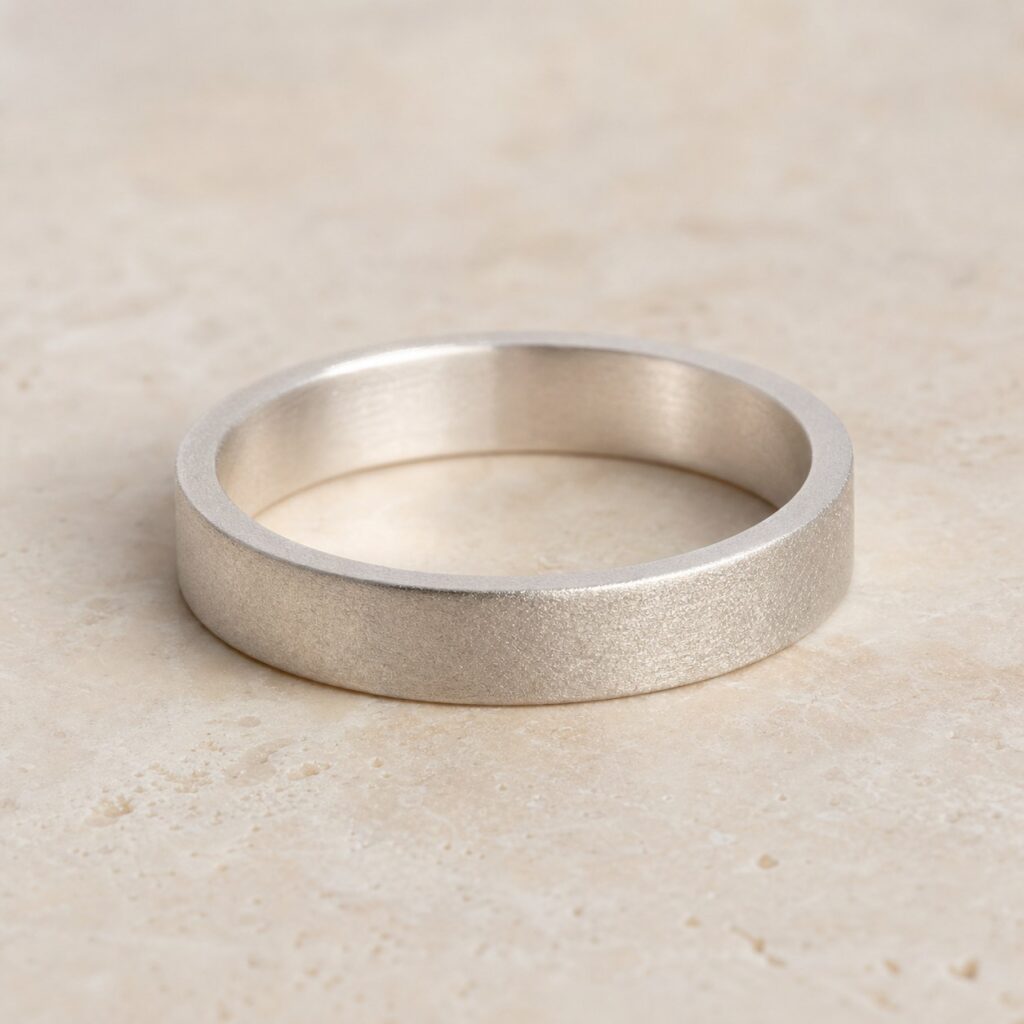
Satin Weight close-up: a satin-matte surface on a medium-width band.
Satin Weight uses a satin-matte finish rather than a reflective face. The product page lists a medium-width profile and a rounded inner edge, giving you a visibly broader option than Quiet Texture.
Choose Satin Weight if the width of the band should be part of the design and you want the surface to return a softer reflection than Mirror Trace.
Quiet Texture: a slim band with a granular surface
Quiet Texture close-up: a fine granular matte surface on a slim profile.
Quiet Texture is the narrowest-looking choice in this comparison. Its product page describes a slim band with softened edges and a fine granular matte texture.
Choose Quiet Texture if you want the surface detail to be visible up close while keeping the overall profile slim.
A simple way to decide
Choose the light response. Start with Mirror Trace for stronger reflection, or one of the matte designs for softer reflection.
Choose the profile. Satin Weight is the current medium-width option. Quiet Texture is slim. Mirror Trace sits between slim and medium in the product description.
Choose the surface detail. Mirror Trace keeps subtle hand marks visible, Satin Weight uses a satin face, and Quiet Texture has a fine granular texture.
If two designs still feel close, compare their detail and worn photographs rather than choosing from the names alone. The close-ups show the finish; the worn images make the profile easier to judge on a hand.
What stays the same across the collection
The current product pages identify all three rings as 999 fine silver. Each product form requires a US ring size from 5 to 12 and includes an optional engraving, name or DIY-text field. The site does not currently publish character or design limits for that field, so confirm a specific request before relying on it.
The choice here is about appearance and profile. For source-checked guidance on material behaviour and skin reactions, read 999 Fine Silver vs 925 Sterling Silver.
For a ring, sterling silver is the harder choice; fine silver is the higher-purity choice. Neither is universally better. Choose sterling silver when resistance to deformation matters more, and fine silver when you specifically want 99.9% silver and accept a softer surface.
First, what does “silver or sterling silver” mean?
Sterling silver is a type of silver alloy, so “silver versus sterling silver” is not a precise technical comparison. In shopping searches, “silver” may mean fine silver, solid silver, silver plate, or simply a silver-coloured material. Ask what fineness and construction the seller actually means.
Schedule 2 of the UK Hallmarking Act 1973 lists 925 and 999 as standards of fineness for silver. Those numbers describe silver fineness; they do not, by themselves, identify the maker, construction or workmanship. For this guide, “fine silver” means 999 silver and “sterling silver” means 925 silver. For the limits of a 925 number or stamp, read what 925 says—and does not say—about silver quality.
999 fine silver and 925 sterling silver compared
Question
999 fine silver
925 sterling silver
How much silver?
999 parts per thousand
925 parts per thousand
Relative hardness
Softer and more malleable
Harder and stronger than fine silver
What does the number tell you?
Silver fineness
Silver fineness
What does it not prove?
Workmanship, exact dimensions, finish quality, durability in a specific routine, or the complete composition of the non-silver portion
Rio Grande’s jewellery-material guide supports the relative hardness comparison. It describes fine silver as very soft and malleable and explains that alloying silver to make sterling increases hardness and strength. This supports a material trade-off; it does not supply a lifespan for a particular ring.
When is sterling silver the better choice?
Consider 925 sterling silver when your main concern is greater hardness than fine silver. That may matter when a design needs more resistance to bending or deformation. It can still be scratched or damaged, and a 925 stamp alone does not prove workmanship.
If you are evaluating a listing, read more than the fineness mark. Look for an accurate material description, clear photographs, dimensions, sizing information and written after-sales terms. Our separate guide explains what 925 says—and does not say—about silver quality.
When is fine silver the better choice?
Consider 999 fine silver when the higher silver content is the feature you want and you are comfortable with a softer metal. Fine silver can show scratches, dents and finish changes through wear. That surface evolution is a trade-off to understand, not evidence that every fine-silver ring is defective.
Forged by You’s current ring listings specify 999 fine silver. Their surfaces can change through wear, and no material choice can be promised to suit every wearer. The choice makes sense only if the material and the expected surface wear fit your priorities.
Does the higher number mean better quality?
No. The number measures silver fineness, not total product quality. A 999 mark indicates more silver than a 925 mark, but it does not rate the accuracy of sizing, the quality of joins, the finish, the design or the seller’s support.
A useful buying decision separates material from execution:
Material: Is the stated fineness documented and described accurately?
Design: Are width, profile and finish suitable for what you want?
Fit: Is there a clear size guide and a written exchange route?
Support: Can you contact the seller, and are warranty terms visible before purchase?
Can both types of silver tarnish?
Yes. The Canadian Conservation Institute explains that silver reacts with sulfur-containing gases to form silver sulfide on the surface. Its discussion also shows why a precise tarnish timetable cannot be promised without knowing the environment and use conditions.
Tarnish therefore remains possible with both 999 and 925 silver. For the mechanism, surface clues and cleaning limits, read does fine silver tarnish?
A practical decision rule
Choose 925 sterling silver if greater hardness relative to fine silver is your deciding factor. Choose 999 fine silver if higher silver content is your deciding factor and you accept the softer material. If a listing only says “silver,” ask the seller to identify the fineness and whether the item is solid silver or plated before buying.
To provide the best experiences, we use technologies like cookies to store and/or access device information. Consenting to these technologies will allow us to process data such as browsing behavior or unique IDs on this site. Not consenting or withdrawing consent, may adversely affect certain features and functions.
Functional
Always active
The technical storage or access is strictly necessary for the legitimate purpose of enabling the use of a specific service explicitly requested by the subscriber or user, or for the sole purpose of carrying out the transmission of a communication over an electronic communications network.
Preferences
The technical storage or access is necessary for the legitimate purpose of storing preferences that are not requested by the subscriber or user.
Statistics
The technical storage or access that is used exclusively for statistical purposes.The technical storage or access that is used exclusively for anonymous statistical purposes. Without a subpoena, voluntary compliance on the part of your Internet Service Provider, or additional records from a third party, information stored or retrieved for this purpose alone cannot usually be used to identify you.
Marketing
The technical storage or access is required to create user profiles to send advertising, or to track the user on a website or across several websites for similar marketing purposes.